Solid vs. Engineered Hardwood: What’s Really Going On Under Your Feet
Ask ten homeowners what “engineered hardwood” is and you’ll get a few confident answers, several guesses and at least one person who assumes it’s a fancy name for laminate. It isn’t. Both solid and engineered floors are real wood, but they are built differently, and those differences decide where each one belongs in a house.
Solid hardwood: one piece of tree
A solid plank is exactly what it sounds like: a single board milled from a log, typically three-quarters of an inch thick, with a tongue on one edge and a groove on the other. It’s the traditional choice, and it’s been nailed down over wooden subfloors for well over a century.
Its great advantage is depth. There is enough wood above the tongue to sand and refinish the floor many times. Its great weakness is movement. Because the grain runs in one direction, the board expands and contracts across its width as humidity changes. In a dry Illinois winter the boards shrink and small gaps open; in a humid July they swell and close again. That seasonal breathing is normal, but it’s the reason solid wood is rarely recommended below grade or directly over concrete.
Engineered hardwood: wood built like plywood
An engineered plank has a top layer of genuine hardwood, called the wear layer, bonded to several layers of plywood or high-density fiberboard underneath. The crucial trick is that each core layer is laid with its grain at right angles to the one below. When one layer tries to expand, the layer beneath it is pulling the other way, and the forces cancel out. The result is a board that moves far less with humidity.
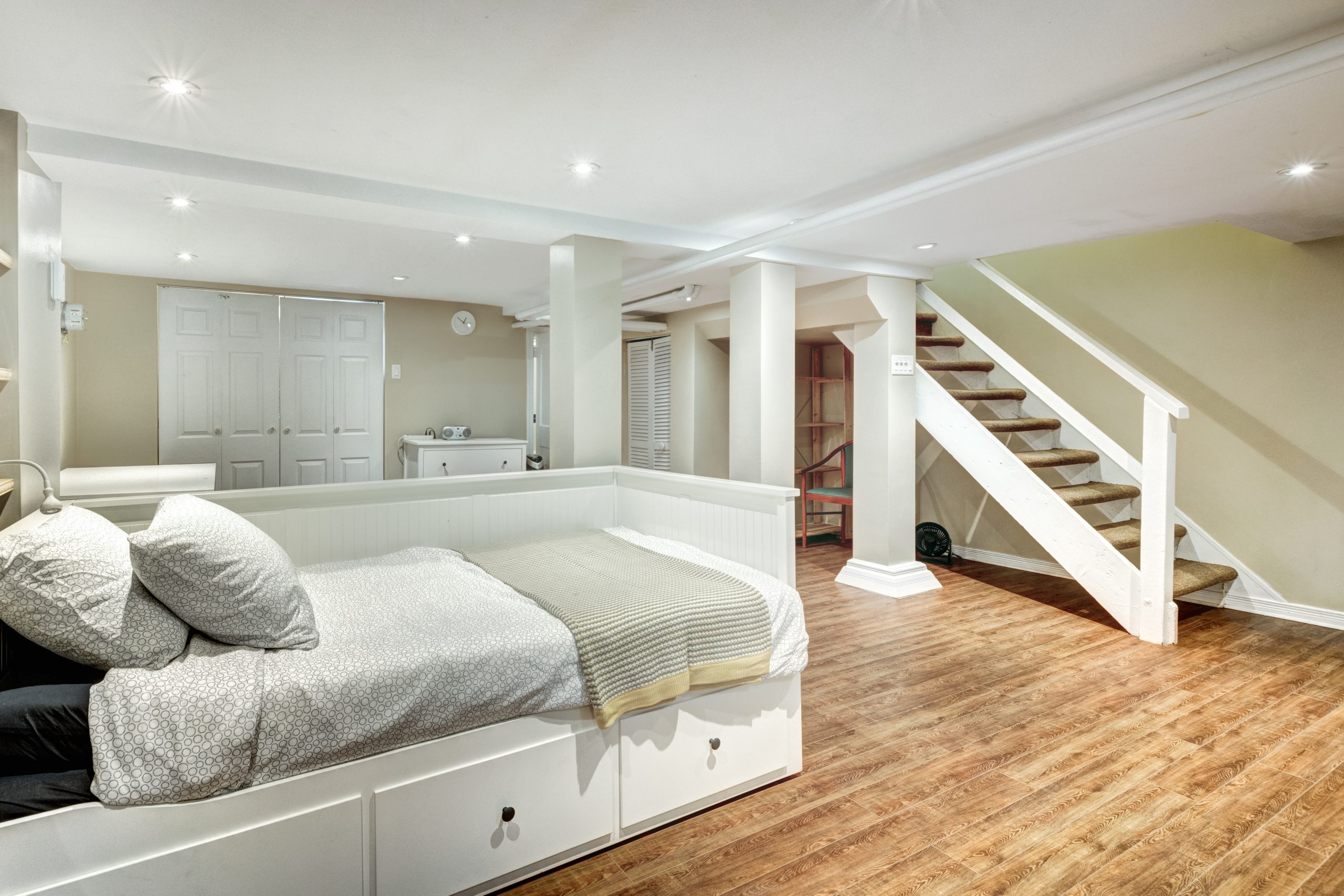
This makes engineered flooring the preferred option for basements, slab foundations and homes with radiant heat, where solid wood would be fighting a losing battle against moisture and temperature swings. It can also be glued, floated or nailed, which gives installers more flexibility.
Anyone comparing options after typing hardwood floor installation near me Algonquin into a search bar will usually find that the question isn’t “which is better” but “which is better for this room.”
The wear layer is the whole story
Not all engineered floors are equal, and the difference lives in that top layer. Budget products carry a veneer as thin as 0.6 millimeters, which is effectively a one-time surface: scratch through it and there’s nothing to do but replace the board. Premium engineered floors have wear layers of 4 to 6 millimeters, which is roughly what a solid plank offers above its tongue. Those can be sanded and refinished two or three times over their life.
So the old claim that “engineered floors can’t be refinished” is half true. Cheap ones can’t. Good ones can, and they’ll last nearly as long as solid wood while behaving better in difficult conditions.
Width, length and why it matters
Both types come in planks from narrow 2¼-inch strips to boards 8 or 10 inches wide. Wide planks are fashionable and show off the grain beautifully, but width amplifies movement. A 7-inch solid oak board will gap and cup more noticeably than a 3-inch one in the same room. This is another place where engineered construction shines: it’s the practical way to get wide-plank looks without wide-plank headaches.
Homeowners researching hardwood floor installation near me Crystal Lake often discover that the floor they loved in a magazine photo is engineered, precisely because it allowed the designer to use those broad, dramatic boards.
Finishes and surface treatments
Both solid and engineered floors are sold either unfinished (sanded and coated on site) or prefinished (coated at the factory). Factory finishes are typically aluminum-oxide-fortified urethanes cured under UV light, and they’re extremely hard. Site finishes are a bit softer but produce a seamless surface with no micro-bevels between boards. Neither is wrong; they just give a different look and a different repair path.
Engineered boards are also where you’ll find most of the current texture trends: wire-brushing, hand-scraping and reactive stains that “fume” the tannins in oak to create those smoky grey-brown tones.
Cost, roughly speaking
Solid and engineered flooring overlap heavily in price. A premium engineered product with a thick wear layer can cost more than a basic solid oak strip. The notion that engineered is the “cheap option” simply doesn’t hold once you look at comparable quality.
Choosing between them
The decision usually writes itself once you answer three questions: Is the room above or below grade? What is the subfloor made of? And is there radiant heat? Solid wood wins for main-floor rooms over wooden joists where longevity is the priority. Engineered wins almost everywhere else.
Whichever direction a search for hardwood floor installation near me Algonquin or hardwood floor installation near me Crystal Lake ultimately leads, both paths end at the same place: real wood, real grain and a floor that will age with the house rather than against it.